
Inside a Session: How Acupuncture Approaches Anxiety and Chronic Stress

Most people who come in with anxiety share a similar story. They mention poor sleep, a tight chest, an inability to switch off, or just feeling like they're running with no energy left. It often gets labelled anxiety but from a Chinese medicine point of view, there’s nuances to it.
What the intake and tongue and pulse assessment usually clarifies is which pattern is driving it. In practice, two come up most often, and they present quite differently.
Two patterns, two presentations
The first is Liver Qi Stagnation. People often describe as being ‘wired’ all the time. The most common symptoms are neck and shoulder tightness, frequent dreaming, and waking multiple times through the night. The pulse tends to be wiry (a pulse quality that is on par with a guitar string). On the tongue, red sides might be seen which would point towards the Liver generating Heat over time. The Heat rises rises and disturbs the Shen (the mind's capacity to settle).
The second is Heart-Spleen Qi and Blood Deficiency. The person is more tired rather than wired. There's often worry, concentration being harder than it used to be, unfreshing sleep, and appetite that is often reduced or irregular. A pale tongue with a red tip is a common finding here, suggesting deficiency with some residual Heart Heat.
Biomedically, both patterns are associated with HPA (Hypothalamic-Pituitary-Adrenal) axis dysregulation. Patients with anxiety disorders frequently exhibit dysfunction of the HPA axis, characterised by excessive secretion of adrenocorticotropic hormone and corticosteroids. Acupuncture may help restore balance to the HPA axis, normalising cortisol secretion and reducing the physiological burden of chronic stress.
What treatment involves
The needling approach depends on which pattern is present. For Liver Qi Stagnation, the focus is on moving Qi and clearing Heat. For Heart-Spleen deficiency, the approach is gentler and more tonifying, since moving Qi aggressively in a depleted person tends to leave them more tired rather than better.
For patients presenting with significant anxiety, I usually like to incorporate a set of points called the Buddha's Triangle. This uses three points together: HT-7, LU-9 and PC-6.
HT-7 sits at the wrist crease on the ulnar side. Its primary action is to calm the Shen and regulate and tonify the Heart. LU-9, also at the wrist, tonifies the Lung, promotes its descending function and regulates the flow through the vessels. PC-6, located on the inner forearm, unbinds the chest, regulates Qi and calms the Shen through the Pericardium, the Heart's protective layer.
Collectively these three points work to settle the spirit, ease chest tightness and support the Heart system from multiple angles at once.
For highly anxious patients, I often apply press tacks to these points at the end of the session. Press tacks are small, hair-fine needles secured with a small adhesive patch that can stay on the skin for a day or two after the appointment. The idea is to extend the treatment effect between sessions. I'll usually suggest massaging each point once or twice a day, or when sitting down in the evening, for about one to two minutes each.
Auricular acupuncture is also worth including. Ear Shenmen is a point on the ear that has a strong calming action on the nervous system. I use an ear seed, a small seed-sized bead adhered to the point, for the same reason as the press tacks. Something patients can engage with between sessions when anxiety rises.
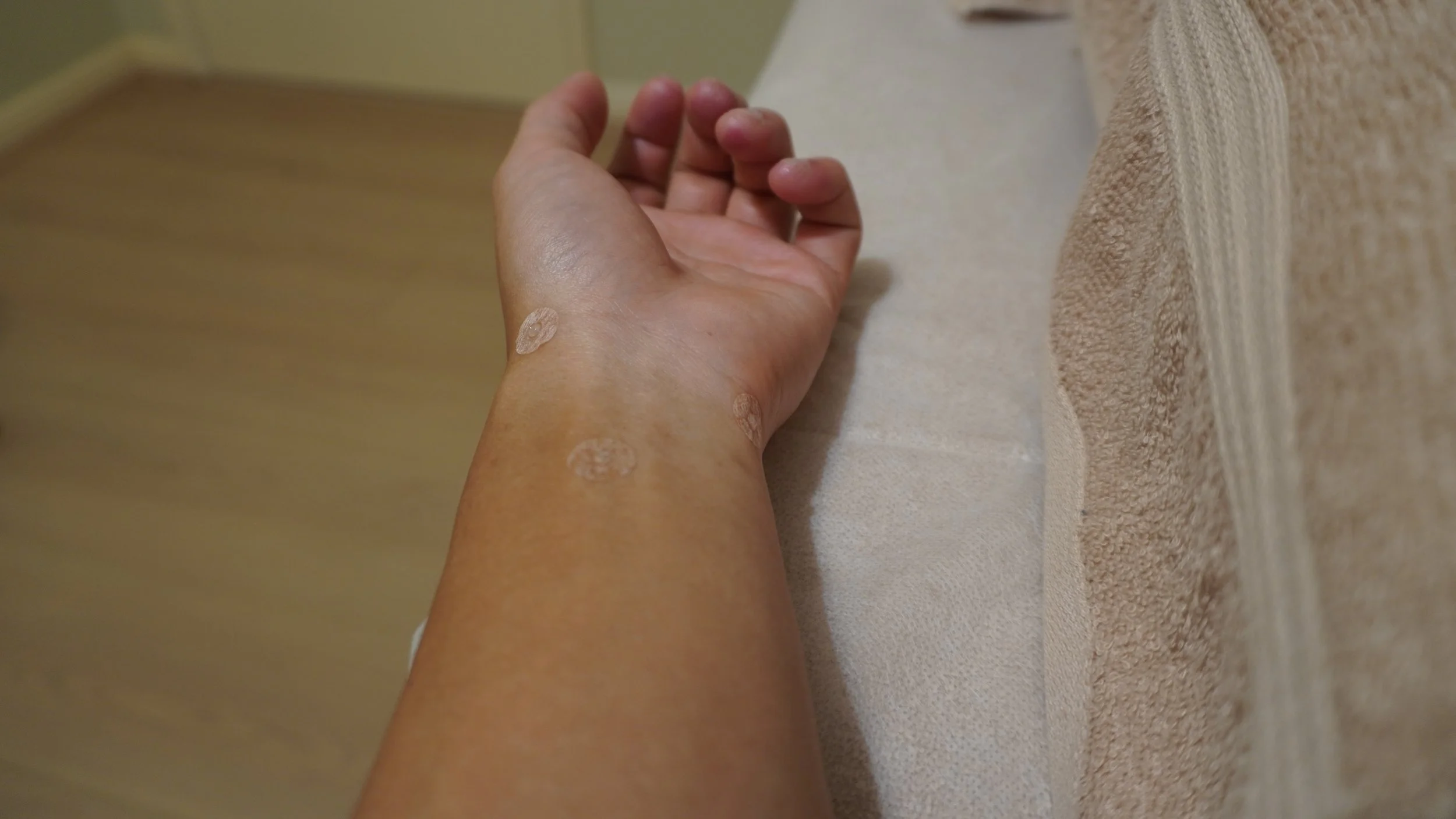
Press Tacks on Budda’s Triangle: HT-7, LU-9 & PC-6.
What patients tend to notice
The most consistent feedback that I like to hear is around two things. The frequency of anxious thoughts reduces. And the sensitivity to triggers isn't as strong. Those are patient descriptions rather than clinical outcomes, but they're a meaningful indicator that something is shifting in the baseline activation level rather than just the symptoms on a given day.
For more established patterns, particularly Heart-Spleen deficiency, Chinese herbal medicine is worth looking at alongside acupuncture. Some deficiency patterns respond better to sustained herbal support between sessions than to acupuncture alone.
A few things worth considering
For Liver Qi Stagnation, alcohol and late nights directly aggravate the pattern. Both prolong the period of the Liver being unable to help the body recover and keep the body in an activated state that the treatment is trying to work against.
For Heart-Spleen deficiency, irregular eating is worth noting. The Spleen in Chinese medicine is weakened by skipping meals, eating while stressed, and relying on stimulants to get through the day. These habits can reduce the body's capacity to generate the Qi and Blood needed to support the Heart system.
Regular movement helps in both cases. Not intense exercise as it could deplete the body further, but walking, stretching or anything that gently moves Qi without demanding too much from a system already under pressure.
What to expect when you visit
The initial consultation covers sleep, stress, energy, digestion and what day-to-day life actually looks like. Tongue and pulse are assessed often to give a picture of which pattern is present and how it's shifting over time.
The point selection is determined by the pattern. For patients with significant anxiety, the Buddha's Triangle and ear seeds are usually a standard part of the session so the treatment continues working between sessions
If any of the patterns above sound familiar, it's worth coming in to see what can be done about them.
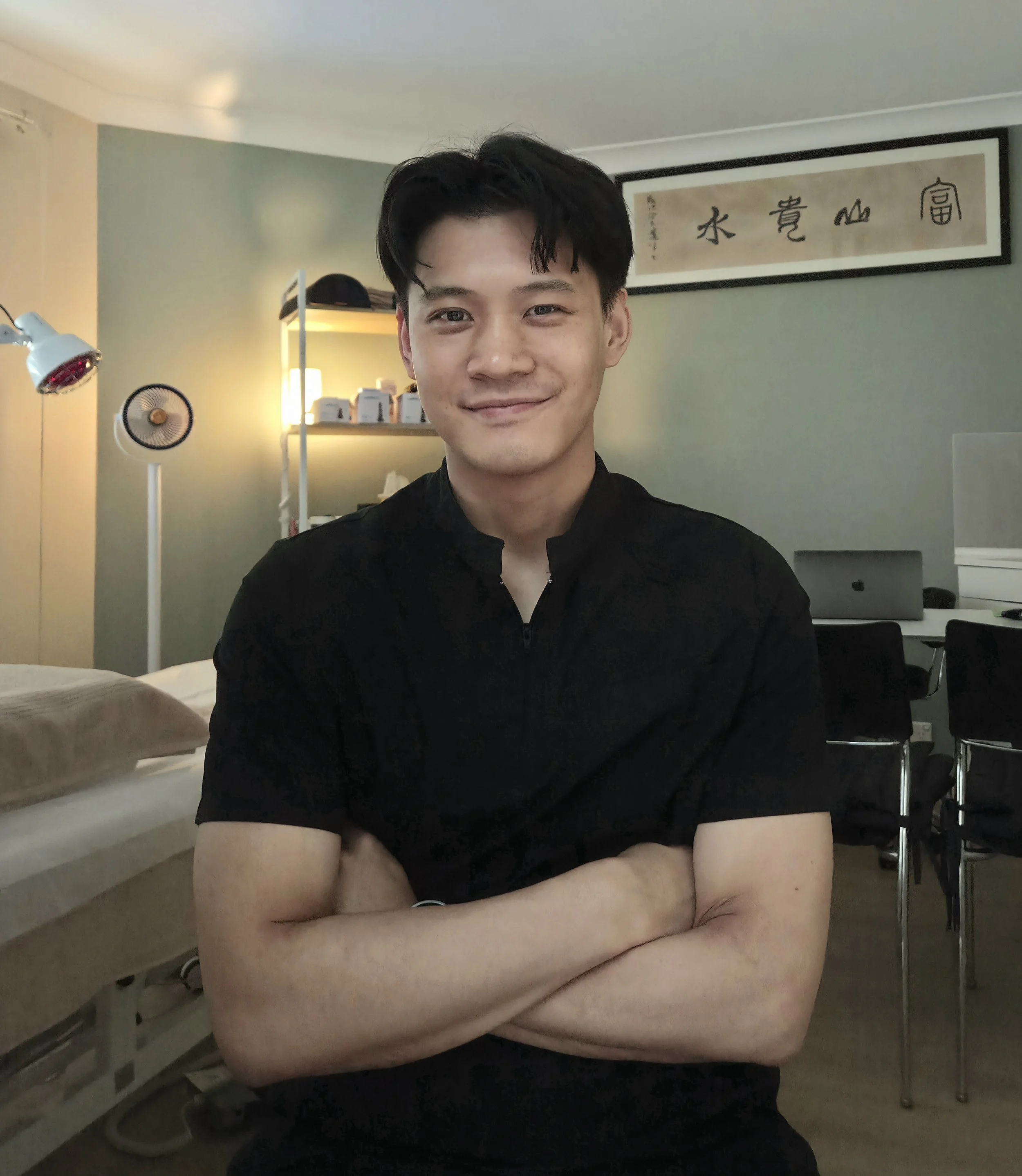
About Brandon Lau
Brandon is a registered Acupuncturist and Chinese Herbal Medicine Practitioner based in Castle Hill, Sydney. He holds a Bachelor of Health Science in Traditional Chinese Medicine from UTS and a Bachelor of Medical Sciences from Macquarie University, and is registered with AHPRA under the Chinese Medicine Board of Australia.
His approach draws on both Chinese medicine and biomedical understanding, with a particular interest in musculoskeletal conditions, stress-related presentations and internal health. He practises at Brandon Lau Acupuncture in Castle Hill and KO Healing Acupuncture in North Ryde.