
Painful Periods and PMS: How Acupuncture and Chinese Medicine Address Menstrual Health
For a lot of women, period pain and PMS symptoms are something they've been told to just manage. Painkillers, heat packs, pushing through. The idea that the cycle itself could be assessed and treated differently doesn't always come up.
Chinese medicine has a detailed framework for understanding menstrual health that goes well beyond symptom management. What the blood looks like, how the pain behaves, what happens in the lead-up to the period — all of it is clinically meaningful.
What a Chinese medicine intake looks like
When someone comes in with menstrual concerns, the intake covers a lot of ground. How long is the cycle, how many days does the period last, when does the pain start and stop, what does the blood look like — colour, consistency, whether there are clots.
PMS symptoms in the lead-up matter too. Breast tenderness, mood changes, bloating, headaches. These aren't separate complaints. They're part of the same pattern.
I also check the temperature of the lower abdomen. This is something that surprises a lot of people. A cold lower abdomen is a meaningful clinical sign in Chinese medicine, and it points toward a specific pattern that shapes how treatment is approached.
Observing the tongue and pulse would finish the picture alongside the standard intake questions around sleep, digestion, stress and energy levels.
What the patterns look like
Chinese medicine identifies several patterns that commonly contribute to menstrual difficulties. In practice they often overlap rather than presenting in isolation.
Liver Qi stagnation is the most common pattern I see. The Liver governs the smooth flow of Qi and Blood throughout the body. When stress is chronic and unresolved, that flow becomes stuck. This tends to show up as cramping, mood changes, breast tenderness and bloating in the week before the period, and pain that improves once the flow starts and things begin to move.
Blood stagnation often accompanies Liver Qi stagnation when the pattern has been present for a long time. The pain tends to be sharper and more fixed, dark or clotted blood is common, and the pain may not fully resolve once the period starts.
Cold in the uterus is a pattern that many women don't realise they have until the lower abdomen is actually checked. The cold impairs the movement of Blood through the uterus, leading to severe cramping, heavy clotting and sometimes a delayed cycle. Symptoms typically improve with the application of heat, which is often the first thing these patients intuitively reach for.
Blood and Kidney deficiency tends to present differently. The pain is usually dull rather than sharp and comes toward the end of the period or after it finishes. The blood is often pale and scanty. There may be fatigue, lower back ache and a cycle that's longer than usual. This pattern tends to show up in people who have been running on empty for an extended period.
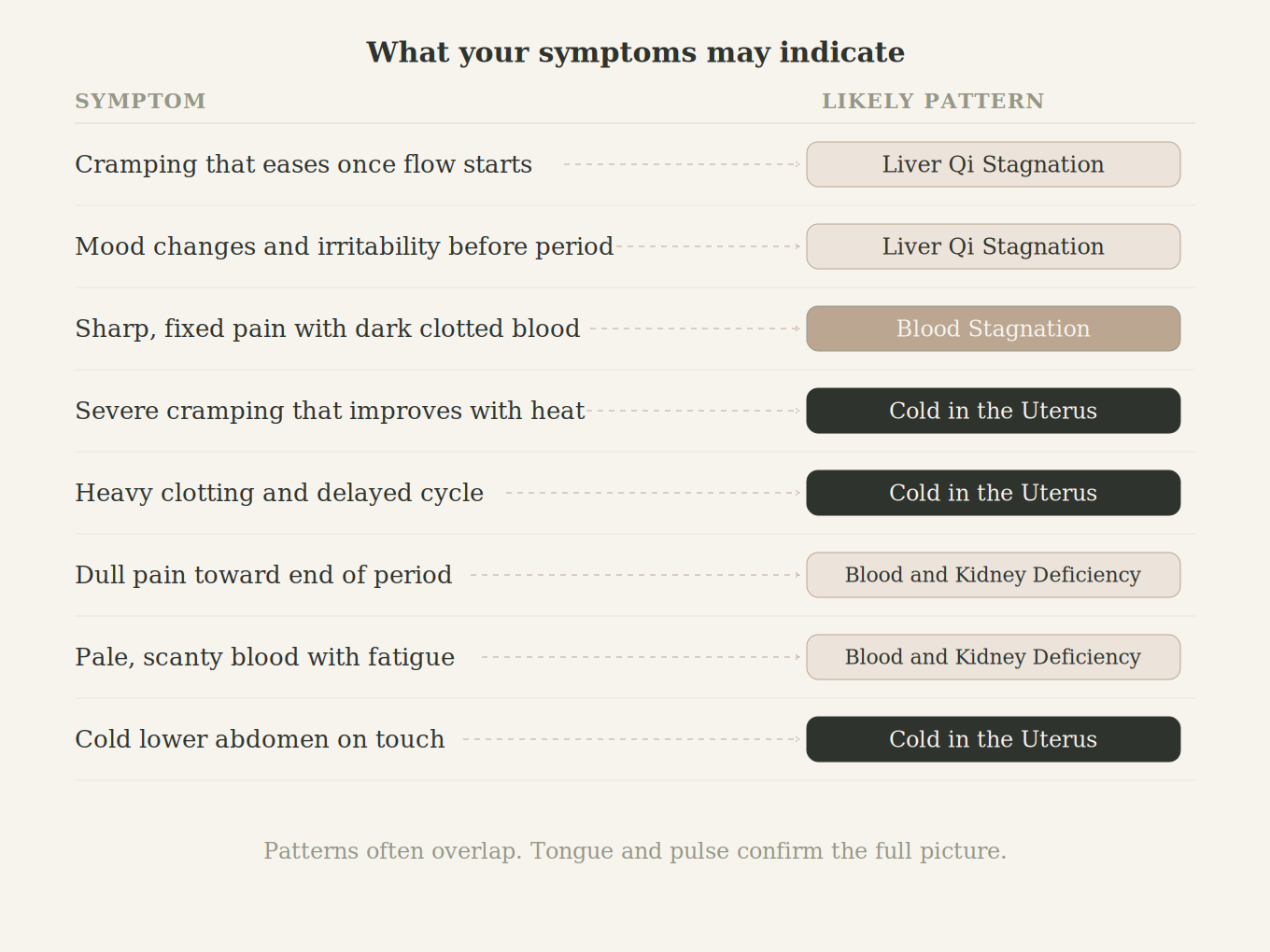
In Chinese medicine, the type of pain, blood colour, and timing of symptoms all point to different underlying patterns.
What treatment involves
The approach would vary depending on which patterns are present, but the focus generally sits across a few areas.
For Liver Qi stagnation and Blood stagnation, the aim would be to move Qi and Blood, reduce cramping and support a smoother flow. A systematic review and meta-analysis of 13 RCTs found that acupuncture and moxibustion were more effective than control groups in managing primary dysmenorrhea, with meaningful reductions in pain scores.
For Cold in the uterus, moxa is particularly worth looking at. Moxibustion involves burning a herb called mugwort near or on acupuncture points. Mugwort has warming properties and generates a deep, penetrating heat that helps warm the uterus, move stagnant Blood and stimulate the local acupuncture points. A moxa box applied to the lower abdomen is a common part of treatment for this pattern.
From a biomedical perspective, acupuncture has been shown to reduce sympathetic nervous system activity, inhibit excessive gonadotropin-releasing hormone secretion, and promote beta-endorphin release, factors that may help restore hormonal balance and support cycle regulation.
For Blood and Kidney deficiency, treatment would look to nourish and build rather than move. Chinese herbal medicine is often worth including here, as some deficiency patterns respond better to sustained herbal support between sessions than to acupuncture alone.
How long it takes
This is worth being direct about. Menstrual patterns take time to shift because the cycle itself only comes around once a month. In most cases it takes around three months of consistent treatment to see meaningful stabilisation in the cycle. Some people notice a reduction in PMS severity or cramping within the first one or two cycles. Deeper patterns, particularly those involving deficiency or longstanding Cold, generally take longer.
The most useful indicator of progress is what happens across consecutive cycles rather than any single session.
Diet and lifestyle considerations
A few things are worth looking at alongside treatment:
Cold foods and drinks: In Chinese medicine, cold impairs the movement of Blood through the uterus. Regularly eating cold or raw foods, particularly around the time of the period, can aggravate cramping and clotting. Warm, cooked foods are generally easier on the system.
Warming teas: Ginger tea is a simple and practical option for warming the uterus and moving Blood. Goji berry and red date tea is also commonly used in Chinese medicine to nourish Blood and support the cycle.
Stress: Liver Qi stagnation is directly aggravated by unresolved stress. Consistent sleep, regular movement and reducing workload in the lead-up to the period can all support what's being done in clinic.
Alcohol: Worth reducing, particularly in the premenstrual phase. It generates Heat in Chinese medicine and can aggravate Liver patterns and worsen PMS symptoms.
What to expect when you visit
The first consultation would start with a detailed conversation about your cycle history, current symptoms and what's been consistent across recent cycles. The intake covers more ground than most people expect, and that detail is what allows treatment to be tailored to the actual pattern rather than a general protocol.
Treatment is typically weekly to begin with, adjusting as the cycle starts to regulate. Chinese herbal medicine may be recommended alongside acupuncture depending on what's presenting.
Three months is a reasonable timeframe to expect meaningful change, though some people notice a difference sooner. A consultation is a good place to start working out what's contributing to the pattern.
About Brandon Lau
Brandon is a registered Acupuncturist and Chinese Herbal Medicine Practitioner based in Castle Hill, Sydney. He holds a Bachelor of Health Science in Traditional Chinese Medicine from UTS and a Bachelor of Medical Sciences from Macquarie University, and is registered with AHPRA under the Chinese Medicine Board of Australia.
His approach draws on both Chinese medicine and biomedical understanding, with a particular interest in musculoskeletal conditions, stress-related presentations and internal health. He practises at Brandon Lau Acupuncture in Castle Hill and KO Healing Acupuncture in North Ryde.