
Neck and Shoulder Tension: A Clinical Approach Using Acupuncture and Tui Na

Neck and shoulder tension is one of the most common presentations I see in clinic. Most people have already tried stretching, heat packs, or massage before they come in. The tension eases for a day or two and then returns. Thus, understanding why it keeps coming back is usually more useful than another round of temporary relief.
Why it keeps coming back
The neck and shoulders don't work in isolation. The muscles most commonly involved are the upper trapezius, levator scapulae, scalenes, sternocleidomastoid (SCM) and suboccipitals. When any of these become overloaded and tight, they develop trigger points, localised areas of hypersensitivity within the muscle that refer pain and restrict movement.
Trigger points don't resolve on their own with stretching alone. They need direct treatment to release the contracted tissue, restore tissue perfusion and allow the muscle to return to its normal resting length.
Chronic stress can magnify the problem. The upper trapezius in particular tends to elevate and guard under sustained stress, which means the pattern is being neurologically reinforced even when someone isn't sitting at a desk. If the stress load doesn't change, the trigger points keep reforming regardless of how well the session goes.
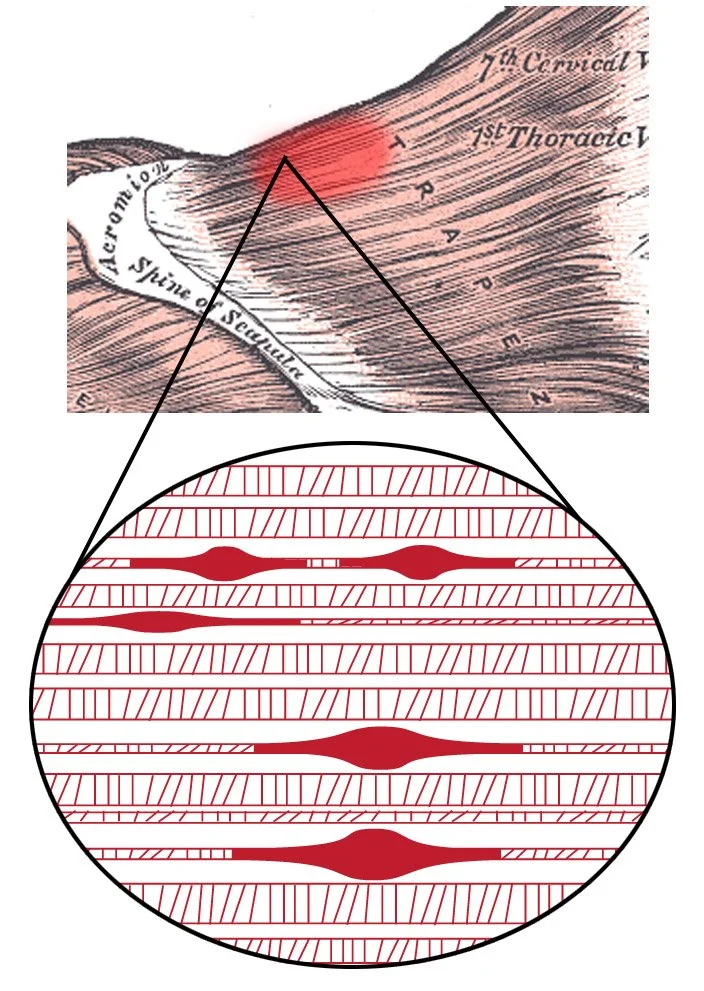
Myofascial trigger point in the upper trapezius.
Image Source: Wikipedia
Upper crossed syndrome
A pattern worth understanding in these cases is upper crossed syndrome. Prolonged sitting and forward head posture causes the upper traps, levator scapulae and SCM to become chronically tight and overactive. The deep neck flexors and lower traps, which are responsible for stabilising the neck and shoulder girdle, become inhibited and weak as a result.
The consequence is that the posterior neck muscles end up carrying far more load than they're designed to handle. For every centimetre the head shifts forward from a neutral position, the effective load on the cervical spine increases significantly. In people sitting at a desk for eight hours a day, that cumulative load is substantial.
This is why treating the neck alone without addressing the broader postural pattern tends to produce short-term results at best.
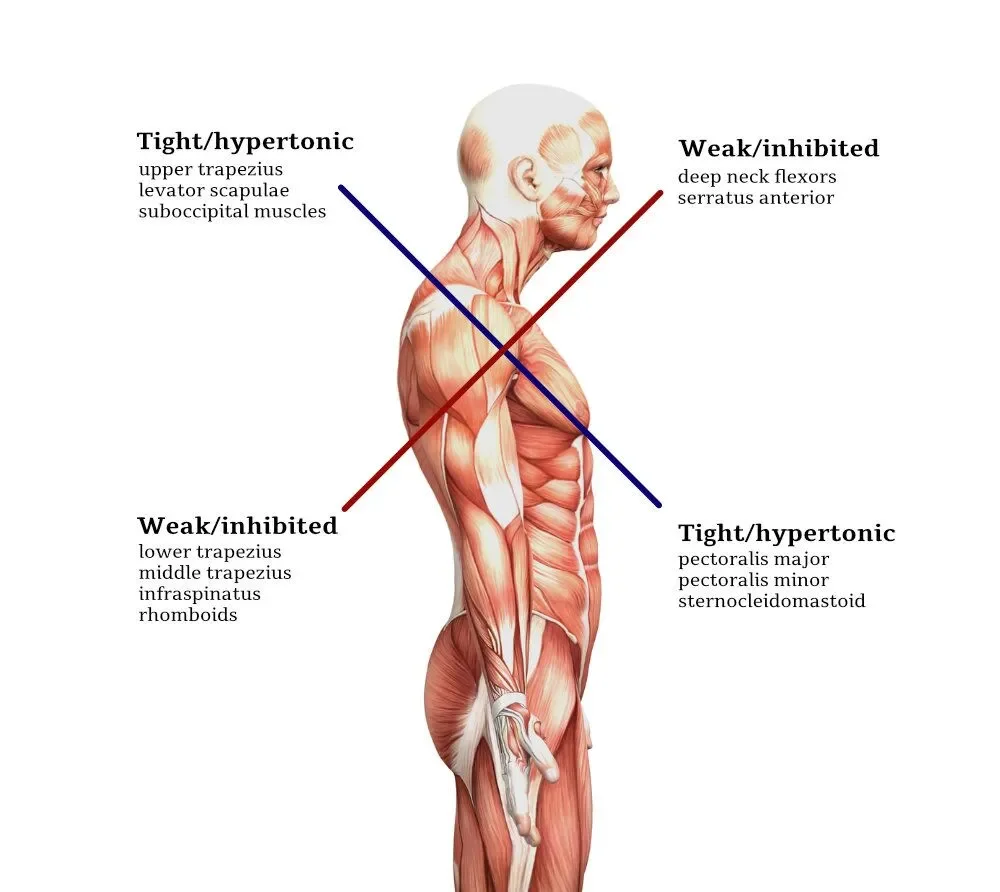
A visual representation of the upper crossed syndrome. Image Source: Yoganatomy
A note on longstanding cases
For older patients or those who have had neck tension for many years, it's worth considering whether there's a structural component. In Chinese medicine, the Kidney governs bones and is associated with the ageing and degeneration of the skeletal system. Chronic neck stiffness that is worse in the morning, slow to warm up and accompanied by reduced range of movement in an older patient may suggest some degree of cervical degeneration alongside the muscular component.
For younger patients, the same principle applies as a preventive consideration. Postural tension that goes unaddressed in the thirties and forties can contribute to structural changes later. Getting on top of the muscular pattern now is worth the effort.
What treatment involves
The approach here is primarily biomedical and sports acupuncture based rather than purely Chinese medicine. The focus is on the muscles directly.
Treatment typically involves acupuncture to the upper trapezius, levator scapulae, scalenes, SCM and suboccipitals, targeting the motor points and trigger points within each muscle. Motor point acupuncture targets the most electrically active point of the muscle, which tends to produce a stronger release response than needling the trigger point alone. I don't usually use motor point stimulation in the first couple of sessions, particularly for someone new to acupuncture, as it can be quite intense until the body adapts.
Electro stimulation is worth adding once the patient is comfortable with needling. It helps sustain the muscle release and improve tissue perfusion beyond what manual needling alone achieves.
Tui Na (Chinese remedial massage) almost always follows the acupuncture. Steady pressure and gentle stretching techniques applied to the neck and upper back help extend the release, encourage blood flow and bring the muscle toward suppleness rather than just reducing pain. In most cases, the muscle needs both the needling to release the trigger point and the manual work afterward to restore normal tissue quality.
Testing before and after
One of the more useful things I do in these sessions is assess range of movement at the start and end of treatment. Left to right rotation and neck flexion and extension give a baseline. After needling and Tui Na, most patients notice they can turn their head more freely. From my side, I'm checking whether the muscle has moved from tense to supple. Both of those changes together indicate the treatment has shifted something meaningful rather than just temporarily reducing pain.
What to expect when you visit
The first thing I'll usually ask is to show me your range of movement. That gives me a picture of where the restriction is and which muscles are most likely contributing. I'll also check the muscle tone directly, feeling for areas of tightness, trigger points and any spots that refer pain on pressure.
From there, treatment is planned around what's actually presenting. For someone new to acupuncture, the first session would focus on lighter needling and Tui Na to introduce the body to treatment before progressing to motor point work.
How many sessions are needed depends on how long the pattern has been there. Recent onset cases often respond quickly. Longstanding patterns with well-established trigger points generally need more consistent work to fully resolve.
If neck and shoulder tension is something you've been managing rather than resolving, it's worth coming in to see what the full picture looks like.
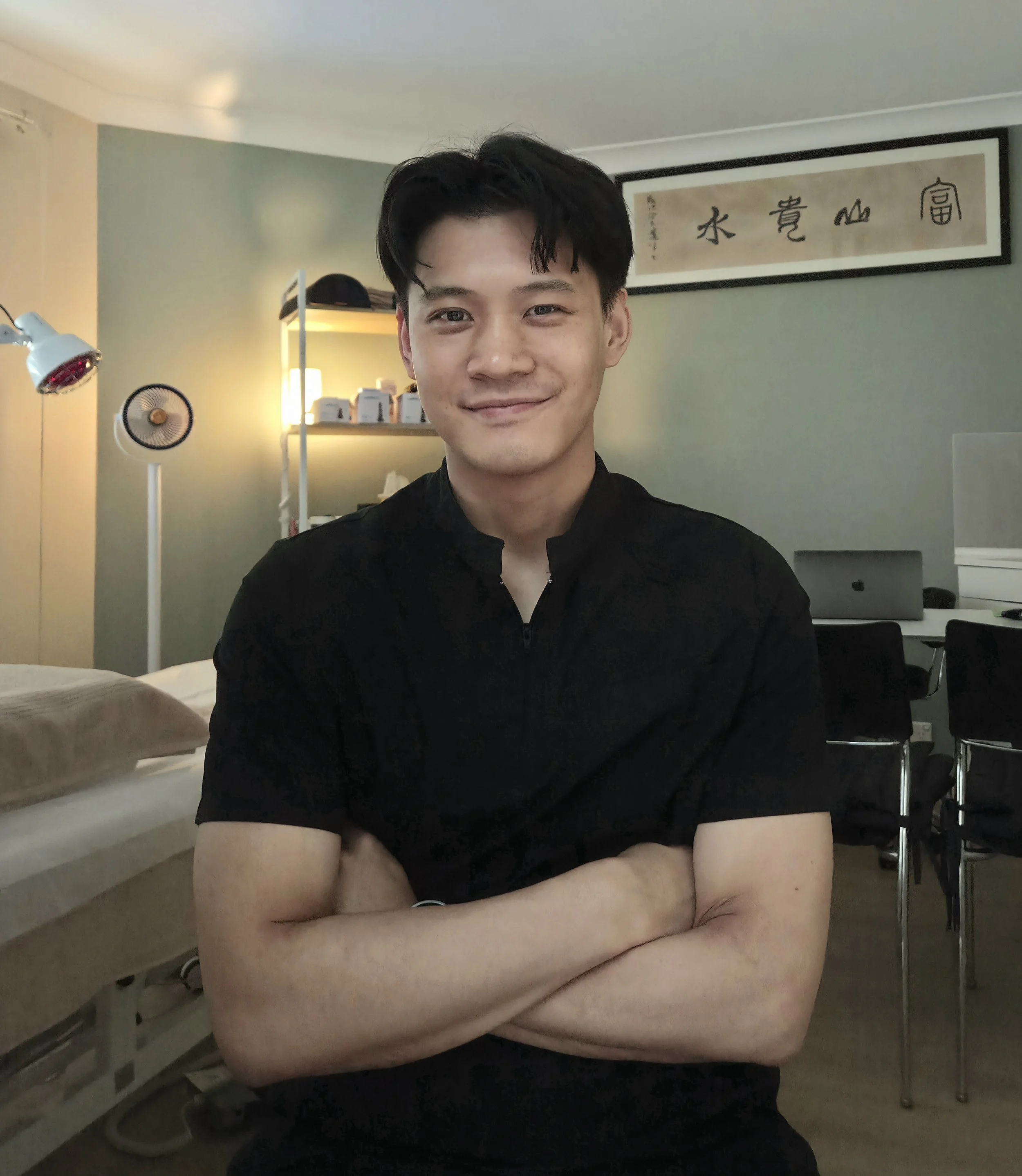
About Brandon Lau
Brandon is a registered Acupuncturist and Chinese Herbal Medicine Practitioner based in Castle Hill, Sydney. He holds a Bachelor of Health Science in Traditional Chinese Medicine from UTS and a Bachelor of Medical Sciences from Macquarie University, and is registered with AHPRA under the Chinese Medicine Board of Australia.
His approach draws on both Chinese medicine and biomedical understanding, with a particular interest in musculoskeletal conditions, stress-related presentations and internal health. He practises at Brandon Lau Acupuncture in Castle Hill and KO Healing Acupuncture in North Ryde.