
Why Your Cough Won't Go Away After a Cold: Acupuncture and Moxa for Post-Viral Phlegm
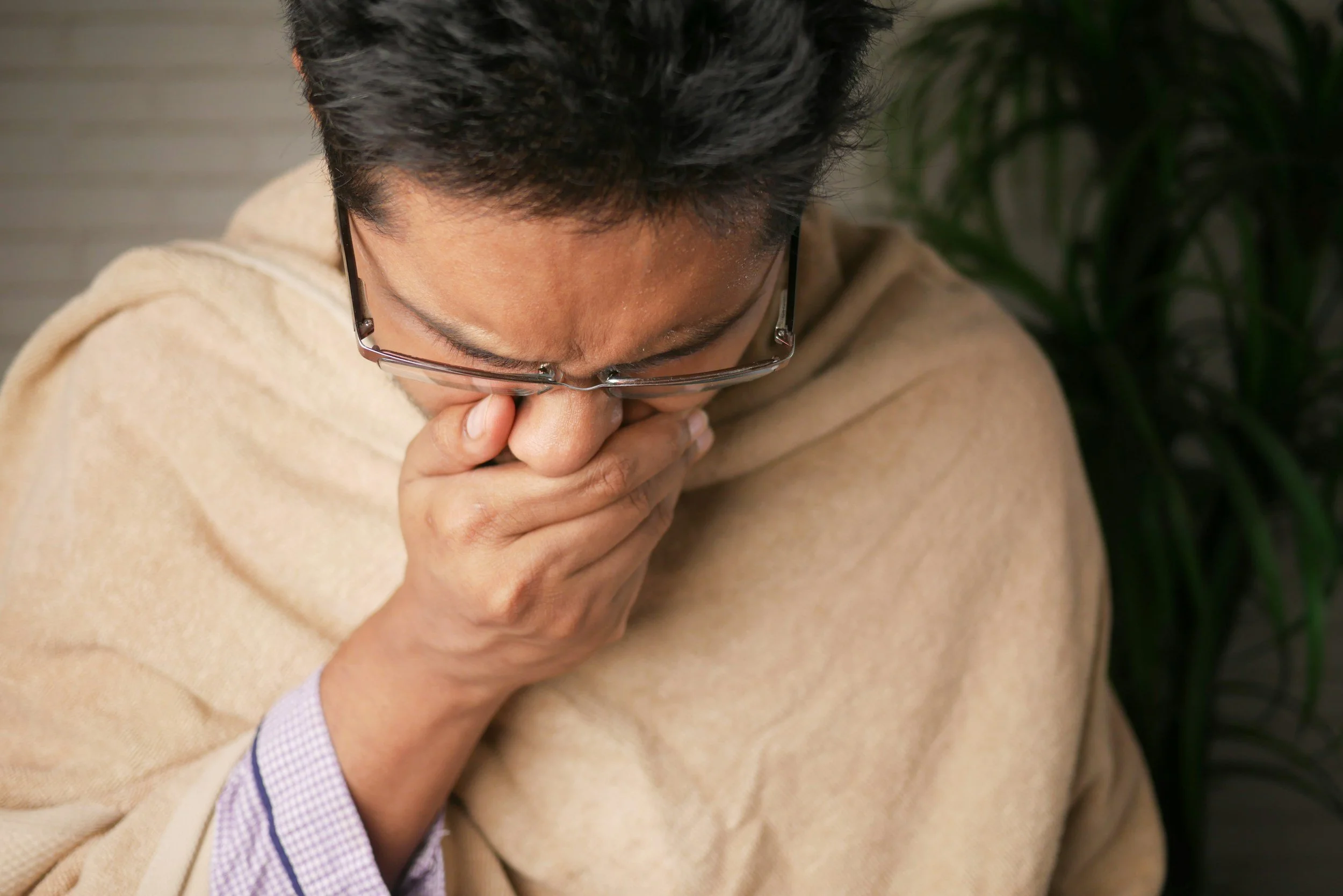
Most coughs after a cold or flu resolve within a couple of weeks. When they don't, there’s something else usually going on. The infection may have cleared but the Lung organ hasn't fully recovered, and a weakened Lung struggles to clear what's been left behind.
Why the cough lingers
In Chinese medicine, the Lung has two key functions that are relevant here. Its descending function moves Qi and fluids downward through the body. Its dispersing function spreads Qi and fluids outward to the body's surface. When the Lung is attacked by a pathogen, whether Wind-Cold or Wind-Heat in Chinese medicine terms, both of these functions can become impaired.
Once the acute infection passes, these functions don't always restore themselves automatically. A weakened Lung that can't descend and disperse properly leaves fluid sitting in the airways rather than moving through. This is where phlegm accumulates and the cough persists.
In Chinese medicine, the Spleen is considered the source of phlegm and the Lung is where it ends up collecting. When the Lung is functioning well, it can clear what the Spleen sends up. When it's not, the accumulation builds.
The Lung also plays a broader protective role. It is responsible for Wei Qi, a defensive layer that works similarly to the immune system, guarding the body's surface against illness. Research has noted that in Lung-deficient patients, markers of immune function including lymphocyte transformation rates are significantly lower than in healthy individuals. This helps explain why some people take much longer to recover after a viral illness, and why they seem to catch things more easily for a period afterward.
What treatment involves
The approach here draws on both acupuncture point selection and moxa to support the Lung's recovery from two angles simultaneously.
Moxa first
Moxa is a warming therapy using the herb mugwort. It works not just by warming the body locally but by improving circulation and supporting the body's capacity to clear accumulation. Research into moxibustion's mechanism suggests it has thermal, radiation and pharmacological effects on tissue, making it useful for moving what has become stuck rather than just addressing cold patterns alone.
REN-17 on the sternum is the primary Moxa point used for this presentation. It sits directly over the chest and in Chinese medicine is used specifically to ease accumulation in the chest and support the Lung's clearing function. GV14, BL11 and BL13 on the upper back are also included where practical, warming the Lung from behind and supporting its overall recovery.
Moxa is used once the acute infection has passed. It is not applied during active illness.
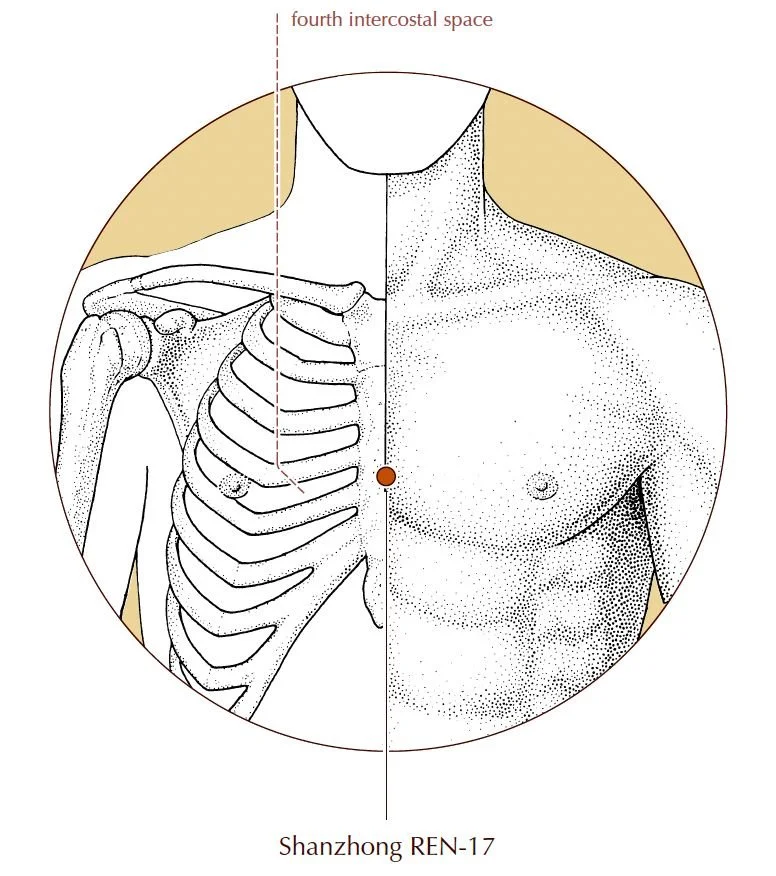
REN-17. Image source from A Manual of Acupuncture by Peter Deadman, Mazin Al-Khafaji, and Kevin Baker.
Acupuncture point selection
The acupuncture approach for post-viral cough draws on channel theory to address the Lung and Spleen system together. In Chinese medicine, the Lung and Spleen belong to the same channel system, called Taiyin. Treating this system as a whole tends to produce better results than treating the Lung alone.
Two point pairs are worth explaining here, as the selection depends on what's presenting.
The first pair is SP-9 and LU-5. These are both uniting points on their respective channels. According to Wang Ju-Yi and Jason Robertson in Applied Channel Theory in Chinese Medicine, this pairing reverses counterflow Qi and regulates the ascending and descending movement within the Lung and Spleen system. It works by stimulating Qi transformation rather than tonifying, making it appropriate when there is active accumulation and counterflow, coughing, phlegm and dampness that need to be moved.
The second pair is LU-9 and SP-3. These are the source and earth points of the Lung and Spleen channels respectively. Robertson describes this pair as having the effect of tonifying and warming the Taiyin, making it appropriate when the presentation is more depleted, lingering cough from deficiency, shortness of breath or lowered lung capacity rather than active accumulation. The two pairs address different aspects of the same underlying pattern and the selection is guided by what is most prominent in the assessment.
ST-40 is included when phlegm accumulation is a significant part of the picture. It is the classic point in Chinese medicine for clearing phlegm and works through the Stomach channel's role in transforming and transporting fluids alongside the Spleen.
A clinical trial using Lung-Taiyin and Stomach-Yangming channel points for post-infectious chronic cough found acupuncture produced a 90% effective rate compared to 80% for drug therapy, consistent with the channel approach described above. A 2024 systematic review and meta-analysis also found acupuncture-related therapy, including Moxibustion, to be a promising treatment for chronic cough across a range of underlying causes.
A few things worth supporting at home
Warm foods and drinks: Cold food and drinks slow the body's ability to clear phlegm. Warm soups, cooked meals and warm water are easier on a recovering system and support the Lung's clearing function.
Avoid dairy: Dairy is considered damp-generating in Chinese medicine and tends to aggravate phlegm production. Worth reducing while the Lung is still recovering.
Steamed pear or apple: A traditional Chinese medicine remedy for lingering cough and phlegm. Steam until soft and eat warm, with a drizzle of honey if preferred.
Almonds: Used in Chinese medicine to moisten the Lung and ease coughing. A small handful daily or blended into warm almond milk.
References
Ha, N.-Y., Kim, K.-I., Lee, B.-J., & Lee, J.-H. (2024). Acupuncture-related therapy for chronic cough: A systematic review and meta-analysis. Medicine, 103(8). https://www.sciencedirect.com/science/article/pii/S2213422025000010
HealthCMi. (2016). Acupuncture relieves chronic coughing for adults and children. https://www.healthcmi.com/Acupuncture-Continuing-Education-News/1652-acupuncture-relieves-chronic-coughing-for-adults-and-children
Wang, J.-Y., & Robertson, J. D. (2008). Applied channel theory in Chinese medicine: Wang Ju-Yi's lectures on channel therapeutics. Eastland Press. https://www.eastlandpress.com/products/applied-channel-theory-in-chinese-medicine-wang-ju-yi-s-lectures-on-channel-therapy
What to expect in a session
The first consultation would start with a conversation about how long the cough has been present, what it feels like, whether the phlegm is clear and watery or thicker and harder to shift, and what the illness looked like at its acute stage.
Tongue and pulse give a picture of whether the pattern is more accumulation-based or deficiency-based, which guides the point selection for that session. Treatment typically combines Moxa over the chest and upper back with acupuncture, adjusted based on what's presenting.
Initially there may be more coughing as the body begins to move what has been sitting there. The focus over time would be to ease accumulation in the chest and reduce the frequency of coughing.
About Brandon Lau
Brandon is a registered Acupuncturist and Chinese Herbal Medicine Practitioner based in Castle Hill, Sydney. He holds a Bachelor of Health Science in Traditional Chinese Medicine from UTS and a Bachelor of Medical Sciences from Macquarie University, and is registered with AHPRA under the Chinese Medicine Board of Australia.
His approach draws on both Chinese medicine and biomedical understanding, with a particular interest in musculoskeletal conditions, stress-related presentations and internal health. He practises at Brandon Lau Acupuncture in Castle Hill and KO Healing Acupuncture in North Ryde.