
Jaw Tension and Teeth Grinding: How Acupuncture and Chinese Medicine Address Bruxism

Jaw tension and teeth grinding is something that often goes unnoticed until it's been building for a while.
By that point, the muscles are overworked and the pattern is fully established. In most cases, there's a stress component sitting behind it.
Why the jaw holds tension
The jaw is one of the first places the body stores unresolved stress. During the day there are enough distractions to override it. At night, when the body finally stops, the accumulated tension has nowhere else to go.
This is why bruxism, the clinical term for jaw clenching and teeth grinding, often happens during sleep. It's not always a jaw problem. It's what the jaw does when the rest of the system hasn't had a chance to relax.
For most people who come in with this complaint, there's usually a stress component. Not always obvious stress. Sometimes it's a low-level chronic activation that's been running in the background for so long it no longer gets noticed.
What Chinese medicine sees
In Chinese medicine, jaw tension and bruxism is most commonly associated with Liver Qi stagnation. The Liver governs the smooth flow of Qi throughout the body. When stress is chronic and unresolved, that flow becomes stuck.
The Liver also governs tendons and sinews. The masseter and temporalis are tendinous muscles, so when Liver Qi stagnates, tension accumulates in these structures directly. This is why treating the Liver pattern tends to produce more lasting results than just working the jaw locally.
The Stomach and Gallbladder channels both run through the jaw region. These channels are worth addressing locally alongside the broader Liver pattern, since releasing tension along the channel pathway supports the overall treatment.
What treatment involves
Local acupuncture at points along the jaw, including ST-5, ST-6, ST-7 and GB-8, aims to release the masseter and temporalis directly. Tui Na massage to these muscles is usually also included as part of the treatment.
The combination aims to produce a noticeable release in the jaw. And so we’re working allow a difference to be felt by the end of the session.
Alongside the local work, the focus would be on addressing the Liver Qi stagnation which is driving the pattern. When Qi moves more freely through the system, the body has less reason to hold tension in the jaw in the first place. That's where the more lasting change tends to happen.
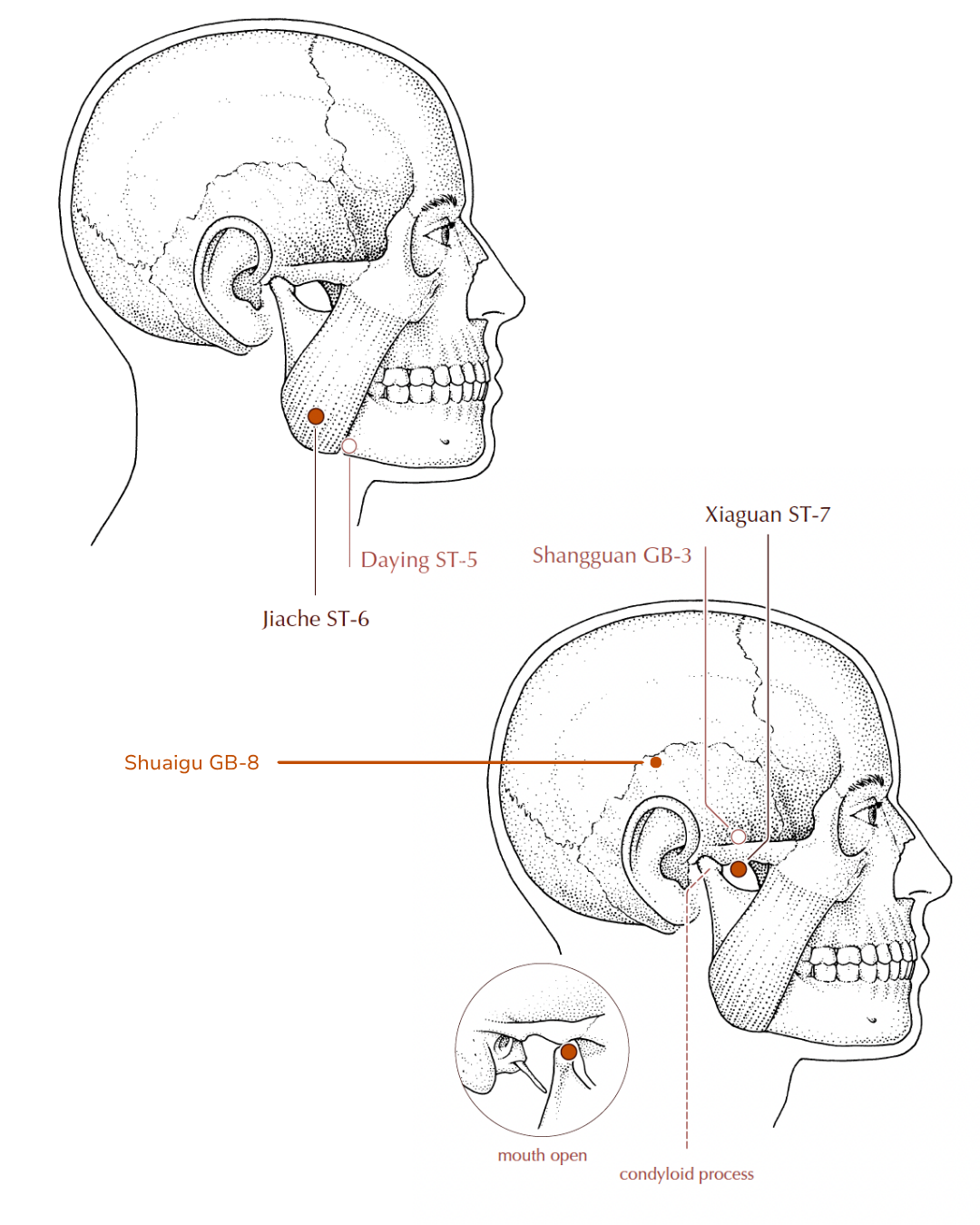
Image source from A Manual of Acupuncture by Peter Deadman, Mazin Al-Khafaji, and Kevin Baker.
Lifestyle and diet considerations
A few things are worth looking at alongside treatment:
Stress load: Liver Qi stagnation is directly aggravated by unresolved stress. Regular movement, better sleep, and time away from screens can all support what's being done in clinic.
Alcohol: Generates Heat in Chinese medicine and can aggravate Liver Qi stagnation over time. Worth reducing if jaw tension is persistent.
Caffeine: Stimulates the nervous system and contributes to a state of chronic activation that makes it harder for the jaw to fully release.
Spicy food: Can generate internal Heat which aggravates Liver patterns. Worth moderating if symptoms are ongoing.
What to expect when you visit
The first consultation would start with a conversation about when and how often jaw tension or grinding occurs, whether there's a stress or sleep component, and any associated symptoms like headaches or neck tension.
Tongue and pulse give a picture of which patterns are contributing. Treatment would typically combine acupuncture with Tui Na massage to the jaw muscles if the intention is to address it locally.
How long it takes to shift will depend on how long the pattern has been established and what's maintaining it.
About Brandon Lau
Brandon is a registered Acupuncturist and Chinese Herbal Medicine Practitioner based in Castle Hill, Sydney. He holds a Bachelor of Health Science in Traditional Chinese Medicine from UTS and a Bachelor of Medical Sciences from Macquarie University, and is registered with AHPRA under the Chinese Medicine Board of Australia.
His approach draws on both Chinese medicine and biomedical understanding, with a particular interest in musculoskeletal conditions, stress-related presentations and internal health. He practises at Brandon Lau Acupuncture in Castle Hill and KO Healing Acupuncture in North Ryde.