
Still Bloated Despite Eating Well? How Acupuncture and Chinese Medicine Address Water Retention

The abdomen feels full. Heavy. Uncomfortable.
You eat reasonably well, you move your body, but nothing seems to shift it. For a lot of people who come in with this complaint, the issue isn't what they're eating. It's how the body is processing fluid.
That's a different problem with a different approach.
How Chinese medicine understands fluid metabolism
The Spleen and fluid transformation
The Spleen in Chinese medicine governs the transformation and transportation of fluids through the body. Think of it like a drainage system. When it's working well, fluids are processed and moved efficiently.
When it's not, they pool and accumulate regardless of how much effort goes in elsewhere. Until the drainage system itself is cleared, the fluid isn't going anywhere.
Spleen function is weakened by poor diet, irregular eating, and prolonged mental strain. That last point is worth noting for people who eat well but still struggle with bloating. Many of the patients I see with this presentation are business owners or office workers carrying a significant stress load.
The diet isn't always the obvious culprit. The state the body is in most of the time is.
The Liver and the stress connection
This connects to the role of the Liver. In Chinese medicine the Liver governs the smooth flow of Qi throughout the body. Chronic unresolved stress causes Liver Qi to stagnate, and a stagnant Liver tends to impair Spleen function directly.
This relationship is described in Chinese medicine as Wood attacking earth. It doesn't apply to everyone, and some people genuinely don't feel stressed. But the body often tells a different story through tight digestion, bloating that worsens under pressure, and bowel habits that shift with workload.
Dairy in Chinese medicine has a damp-generating quality that places additional burden on an already struggling Spleen. Alcohol generates damp heat, which compounds fluid accumulation and makes the pattern harder to shift. Neither needs to be eliminated entirely, but they're worth looking at honestly.
The Kidney and long term fluid regulation
In older patients, or those who have been running on empty for a long time, there is often a Kidney component as well. The Kidney in Chinese medicine plays a root role in fluid regulation. When it's depleted, the body's capacity to process and excrete fluid at a deeper level is reduced.
Treatment in these cases would aim to address all three organ systems rather than just the most immediate presenting layer.
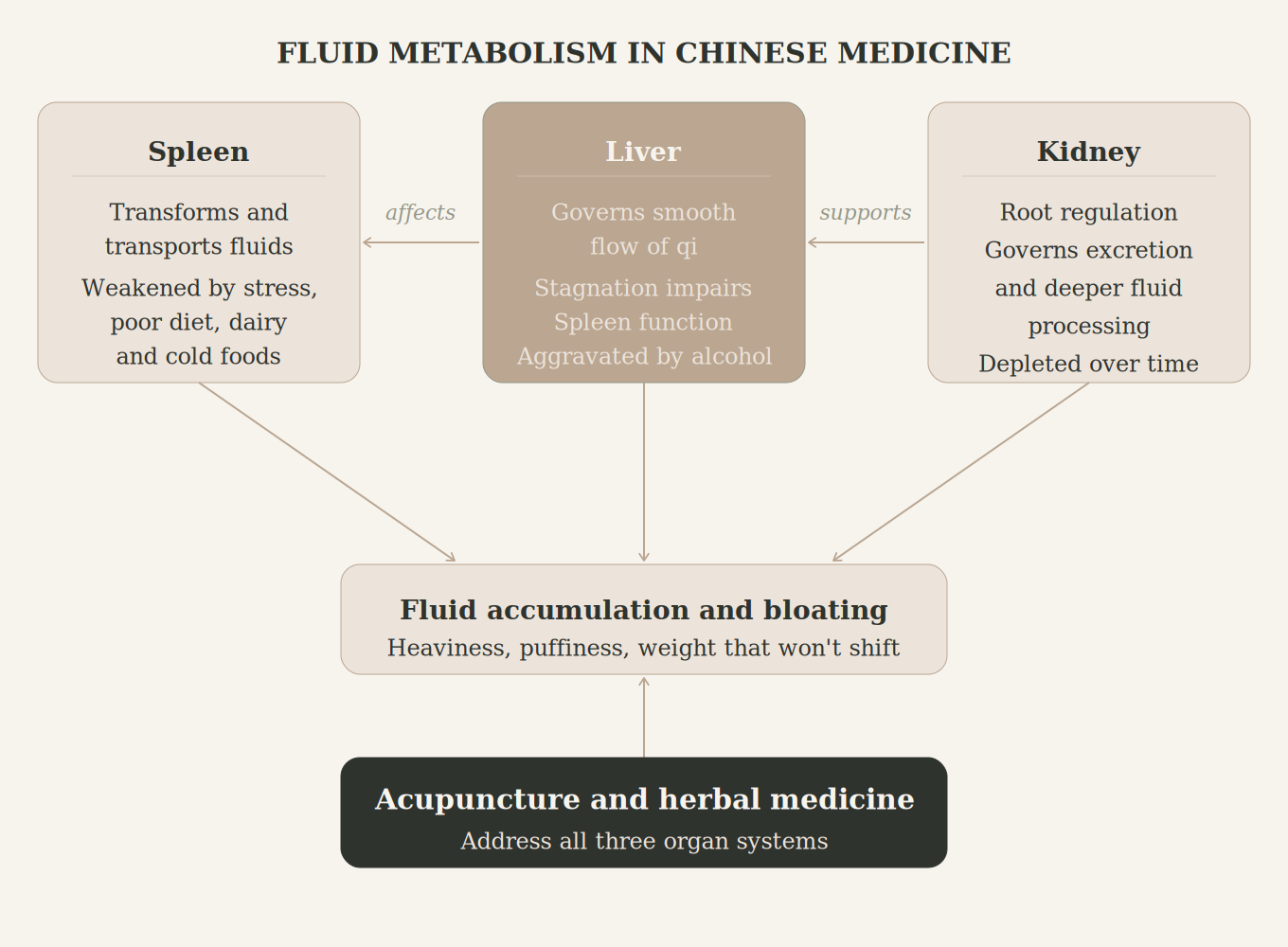
Chinese medicine diagram showing how Liver, Spleen and Kidney dysfunction leads to fluid accumulation and bloating, addressed through acupuncture and herbal medicine.
What treatment would look at
The focus would be on strengthening Spleen function, moving Liver Qi, and where relevant, supporting the Kidney.
Moxa is particularly useful alongside acupuncture for this kind of presentation. Warming the abdominal region through moxibustion helps improve local circulation and supports Spleen yang, the warming and activating aspect of Spleen function that tends to be most affected in these cases.
In clinic I sometimes observe the abdomen becoming noticeably flatter either by the end of a session or over the hours and days that follow. It doesn't happen every time and depends on what's driving the pattern. But when it does, it's a useful indicator that the body has the capacity to respond.
It's not a guarantee, but it's an encouraging sign.
Chinese herbal medicine can also be prescribed to support the work between sessions, particularly where the pattern has been established for a long time.
A few things worth considering
Cold and raw foods place additional demand on Spleen function. The Spleen in Chinese medicine prefers warmth. Regularly eating cold, raw or heavily processed food makes its job harder.
Warm, cooked meals are generally easier for a compromised Spleen to handle.
Stress is harder to prescribe around but worth acknowledging. If the Liver is consistently under pressure, treatment gains tend to be slower. Small reductions in load, more regular meals, better sleep, and time away from screens can all support what's being done in clinic.
What to expect when you visit
The first consultation would start with a conversation about digestion, energy, stress and lifestyle. I'd ask about diet, bowel habits, how the abdomen feels at different times of day, and whether symptoms shift around the menstrual cycle if relevant.
Tongue and pulse give a picture of which organ systems are under strain and how the overall pattern is presenting. From there, treatment is tailored to what's actually showing up rather than a standard protocol.
How long it takes to shift depends on how long the pattern has been there and what's maintaining it. A consultation is a reasonable place to start working that out.